Cost to fix an iPhone in Australia: A Friendly Guide to Repair Prices

That heart-stopping moment when your iPhone hits the pavement is almost always followed by one big question: "What's the cost to fix my iPhone?"
Here in Australia, the answer can be anything from a relatively small $45 for a simple fix to a wallet-clenching $679 for major surgery on a newer model. It all comes down to the extent of the damage, which iPhone you have, and who you trust with the repair.
Your Quick Guide to iPhone Repair Costs
When your go-to device takes a tumble, the first step is figuring out the financial damage. The price to fix an iPhone isn't one set figure; it’s a sliding scale that depends on the model, the specific part that's broken, and where you take it.
For many people, the final bill can be a real shock, especially with newer models that have fancy screen technology and tightly integrated components. In 2025, the median repair cost is hovering around $362—a number that’s big enough to make you stop and think about your options.
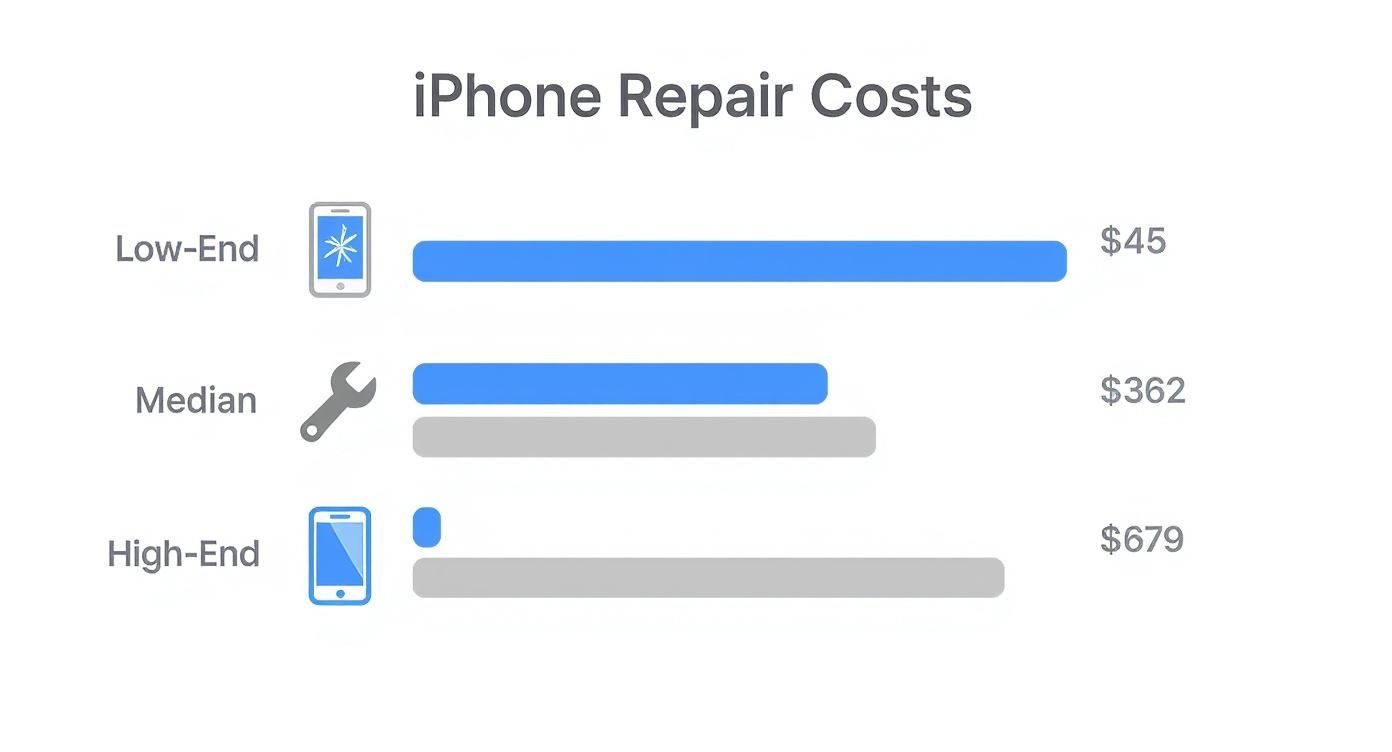
While some minor fixes are affordable, a screen replacement alone can run you anywhere from $45 to $679. Even something as common as a faulty charging port can set you back between $79 and $279. You can explore more details on repair pricing trends to see how these costs stack up.
As the chart shows, while some repairs are manageable, the potential for a hefty bill is always there, often creeping closer to the cost of a brand-new or quality refurbished device. This massive price range is exactly why getting a firm quote before you agree to any work is an absolute must.
Estimated iPhone Repair Costs in Australia
To give you a clearer picture, we've put together a table outlining the typical price ranges for the most common iPhone repairs across different generations. Keep in mind these are estimates—the final price will always depend on the repairer and the quality of the parts they use.
| Repair Type | Older Models (iPhone 8/X) | Mid-Range Models (iPhone 11/12) | Newer Models (iPhone 13-15) |
|---|---|---|---|
| Screen Repair | $99 - $189 | $189 - $469 | $469 - $679 |
| Battery Change | $79 - $129 | $129 - $159 | $159 - $189 |
| Charging Port | $79 - $129 | $99 - $159 | $159 - $279 |
| Back Glass Repair | $99 - $199 | $199 - $349 | $349 - $599 |
As you can see, the newer your iPhone, the more expensive it is to fix. The advanced OLED screens and complex construction of the latest models mean parts and labour costs are significantly higher, which is a crucial factor when deciding whether to repair or replace.
Decoding the Price Tag on Common iPhone Repairs
Not all iPhone damage is created equal, and neither are the repair bills. To get a real sense of what it might cost to fix your iPhone, you need to look at the specific problem you’re facing. Let's break down the most common repairs to give you a clearer idea of what to expect.
Screen Replacements: The Most Common Culprit
A cracked screen is, without a doubt, the most frequent issue we see. It’s also where the price can swing wildly depending on your model’s screen technology. Older iPhones with simpler LCD screens are far cheaper to fix, sometimes coming in at under $100.
But if you’ve got a newer model with a fancy OLED display, it’s a whole different ball game. These vibrant, complex screens cost more to make, which pushes the repair price way up. A shattered screen on a recent iPhone Pro Max can easily set you back more than $600.
In Australia, screen repair prices vary massively. An iPhone 13 mini screen might cost between $280 and $425, while a base iPhone 15 starts around $190 but can climb to $535. For the top-tier models, an iPhone 15 Pro screen repair can range from $215 to $610, and the Pro Max can hit a hefty $690.
Battery and Charging Port Fixes
After screens, batteries are the next big thing. If your iPhone just can’t hold a charge like it used to, a new battery is a brilliant and cost-effective way to give it a new lease on life. You’re typically looking at somewhere between $80 and $190, depending on the model.
A dodgy charging port is another common frustration, but thankfully, it's usually a straightforward fix. Expect to pay anywhere from $80 to $280 to get your iPhone charging properly again.
Key Takeaway: While screen repairs see the biggest price jumps between models, essential fixes like battery and charging port replacements remain relatively affordable ways to extend your iPhone's lifespan.
Other Common Repair Costs
Of course, it’s not just screens and batteries that can fail. Here’s a quick look at what you might be up for with other common issues:
- Camera Module Repair: Photos coming out blurry? Camera app crashing? You might need a new camera module. This can cost between $100 and $300. Unsurprisingly, the Pro models with their more complex camera systems sit at the higher end of that range.
- Water Damage Assessment: This is the big unknown. The first step is getting a technician to diagnose the extent of the damage, which usually costs between $50 and $150. The final bill, however, depends entirely on which internal parts have been fried and need replacing.
Thinking about repair costs isn't just for phones. In the same way, understanding service pricing models in other industries gives you the power to spot good value and make smarter financial decisions, whether you're fixing a phone or hiring a service.
Why Do iPhone Repairs Often Cost More Than Android?
Ever had that sinking feeling when you get a repair quote for your iPhone and wonder why it seems so much higher than what your friend paid for their Android? You're not just imagining it. There's a real price gap, often called the "Apple tax," and it all comes down to Apple's tightly controlled world.
From day one, Apple designs its products in a closed-loop ecosystem. This means they use their own proprietary parts, require specialised tools for repairs, and rely on exclusive software for diagnostics. This control snakes all the way down their supply chain, making it a real challenge for independent repair shops to get their hands on genuine components at a reasonable price.
The Price Gap in Action
This premium becomes crystal clear when you put the numbers side-by-side. Here in Australia, the difference can be pretty significant. A typical screen replacement for an iPhone can set you back anywhere from $150 to over $400, whereas a similar Android screen often lands between $90 and $250. That’s a potential premium of 50% or more just for the Apple logo.
The story is the same for batteries. You’re looking at an average of $70 to $120 for an iPhone battery swap, compared to $40 to $80 for most Android models. It's not just about the parts themselves; it’s about control. Apple's strict approach has historically made life difficult for third-party repairers, a topic we dive into in our article about why Apple is so against third-party repair shops in Australia.
The Bottom Line: Apple's iron grip on its parts and repair processes means less competition in the market. That almost always leads to higher prices for you, the customer. You get a premium device, but the long-term cost of keeping it alive can be much higher if something goes wrong.
Design Complexity and Integrated Components
Beyond the supply chain drama, the physical design of iPhones adds another layer to the cost. Apple is famous for its sleek, compact designs where every millimetre counts. While this looks fantastic, it makes getting inside to fix things a lot more complicated.
This design philosophy creates a few hurdles:
- Specialised Labour: Technicians often need extra training and specific tools just to open an iPhone without causing more damage.
- Component Pairing: In newer models, parts like the camera or screen are digitally "paired" to the phone's main logic board. If you replace one without Apple's official software to authorise it, you can lose key features or get persistent error messages. This tactic often pushes you back towards Apple's more expensive, official repair channels.
What might be a straightforward part swap on an Android device can become a delicate, time-consuming operation on an iPhone, and that extra labour cost gets passed onto your final bill. That beautiful design is a huge part of the appeal, but it's also a big reason the cost to fix an iPhone remains stubbornly high.
Choosing Your Repair Path: Apple vs. Independent vs. DIY
When your iPhone gives up the ghost, you’re faced with a big decision that goes well beyond the repair bill. The path you choose—going straight to Apple, visiting a local independent shop, or tackling it yourself—will impact the price, the quality of the repair, and your own peace of mind. Let's map out these three very different routes.
The Official Route: Apple and Authorised Service Providers
Opting for Apple or an Apple Authorised Service Provider (AASP) is easily the safest, most straightforward choice. Think of it as the manufacturer's guarantee. You’re assured of getting genuine Apple parts, fitted by technicians who are trained and certified to Apple's exacting standards.
Going official comes with some serious perks:
- Guaranteed Quality: The parts are authentic, which means a new screen will have the exact same touch response and colour accuracy as the original. A new battery will meet the original performance specs, no questions asked.
- Warranty Protection: The repair itself is backed by an Apple warranty. Crucially, it won’t void your existing device warranty if you still have one.
- Peace of Mind: You know the job will be done right, with diagnostics run using official Apple software. There's no guesswork involved.
Of course, this premium service comes at a premium price. The official route is almost always the most expensive option. You’ll also likely need to book an appointment and wait, which isn't ideal if you need a fix in a hurry.
The Independent Repair Shop: A Balance of Cost and Convenience
For many Australians, independent repair shops are the go-to for a faster, more affordable fix. These local businesses, common in cities like Brisbane and right across the country, often offer incredible turnaround times—sometimes they can even swap a screen while you wait. The cost to fix an iPhone at these shops is typically much lower than what Apple charges.
But this convenience comes with a trade-off: quality can be a bit of a gamble. Independent shops use a whole range of parts, from high-quality components designed to "OEM-spec" all the way down to cheap aftermarket alternatives that might mess with your screen’s brightness or battery life. It's vital to ask what grade of parts they use and what kind of warranty they offer on their work.
Pro Tip: Before you hand over your phone to an independent repairer, always check their Google reviews and ask specifically about their warranty on both parts and labour. A reputable shop will be completely transparent about both.
The DIY Path: For the Brave and Tech-Savvy
For those who are confident with tiny screws and delicate connectors, the Do-It-Yourself (DIY) route offers the biggest potential savings. You simply order the parts and tools online and perform the repair yourself, cutting out all labour costs. It can be a rewarding and extremely cost-effective option—if you pull it off.
The risks, however, are substantial. One wrong move or a slip of the hand can turn a simple screen repair into a completely dead iPhone. You also have zero warranty on your own work, and just finding reliable, high-quality parts can be a real challenge.
For anyone curious about this path, exploring the details of Apple's Self Service Repair program is a good starting point. It gives you a clear idea of the complexities involved, even when using official parts. DIY is best left to those with experience and a very steady hand.
Making the Call: Should I Repair or Replace My iPhone?
Staring at a hefty repair quote brings up that dreaded question: is it finally time to move on from your trusty iPhone? It can feel like a complicated financial decision, but a simple rule of thumb often cuts right through the confusion. It really just comes down to weighing the cost to fix your phone against what it's actually worth today.
This process doesn't have to be a headache. By looking at a few key factors, you can confidently decide whether to repair, replace, or even choose a smarter third option you might not have considered.
The 50% Rule: A Simple Guideline
Here’s a straightforward way to start. If the repair quote is more than 50% of your iPhone’s current value, it’s time to seriously consider an alternative.
For example, let's say your iPhone 12 is worth around $400 on the second-hand market. If you get a screen repair quote for $250, you’re already past that halfway mark. Sinking that much cash into an older device often isn't the best financial move. The value of your phone will only continue to drop, and you might just face another costly repair down the line as other components start to age.
Think of it like this: Spending a large sum on an old phone is a bit like paying for major engine repairs on an old car. Sometimes, that money is better put towards a more reliable, newer model that won't give you headaches a few months later.
Key Factors to Consider
Before you pull the trigger, ask yourself a few critical questions. Your answers will point you toward the most sensible choice for your situation.
- How Old Is Your iPhone? If your device is more than three or four years old, it may no longer receive the latest major iOS updates. This means you could miss out on new features and, more importantly, critical security patches.
- How Severe Is the Damage? A cracked screen is one thing. But multiple issues—like a failing battery, a broken charging port, and a smashed back glass—can add up incredibly fast. One expensive repair might be worth it, but a laundry list of problems is often a sign it's time to let go.
- What’s Your Budget? Can you comfortably afford the repair, or would that money be better served as a down payment on a different device? Be realistic about what makes the most financial sense for you right now.
The Smart Alternative: Trading In for a Refurbished iPhone
Here's the thing: repairing isn’t your only option, and buying brand-new isn’t either. There's a brilliant middle ground that’s often the most cost-effective and sustainable choice you can make: trading in your damaged iPhone and putting the credit towards a certified refurbished model.
At Trade.com.au, we can assess your damaged device and give you a fair trade-in value for it. You can then use that credit to significantly lower the price of a high-quality, fully tested refurbished iPhone that comes with a 12-month warranty.
You get a like-new phone for a fraction of the cost, avoid a pricey repair bill, and do something good for the planet by keeping tech in circulation. Why not explore the latest refurbished iPhones and see how much you could save?
How to Find a Trustworthy Repair Service in Australia
Finding a skilled and honest technician can feel like searching for a needle in a haystack. Get it right, and you’ll save a ton of money and stress. Get it wrong, and you could end up with more problems than you started with. The goal is simple: find a shop that’s transparent, knows their stuff, and stands by their work.
So, where do you start? Your first port of call should always be online reviews. A quick search on Google will tell you a lot about the local options. Look for genuine customer feedback and pay attention to patterns—consistent praise for customer service and quality is a massive green flag. It's worth digging into what makes a business's reputation solid, like understanding how businesses build trust through online reviews, to help you spot the real deal.
Key Questions to Ask Before You Commit
Once you have a shortlist, it’s time to play detective. Before you even think about handing over your phone, give them a call or drop in and ask a few direct questions. A good technician will have no problem giving you straight answers.
- What kind of parts do you use? Repair shops might use genuine Apple parts, high-quality OEM (Original Equipment Manufacturer) equivalents, or cheaper aftermarket parts. This choice directly impacts both the cost to fix the iPhone and how well it performs down the track.
- What is your warranty policy? Never, ever agree to a repair without a warranty. It should cover both the new parts and the labour. A 90-day warranty is the absolute minimum, but the best shops will offer six months or even a year.
- Can you provide a detailed quote? A reputable service will give you a clear, itemised quote before they start any work. This ensures you won't get hit with any nasty surprises when it's time to pay the bill.
Crucial Tip: Before you drop your iPhone off anywhere, it’s vital to back up your data and secure your personal information. A few simple steps can protect your privacy and give you peace of mind. Find out exactly what to do in our guide on how to secure your phone before a repair.
Arming yourself with these questions will empower you to find a reliable service anywhere in Australia, ensuring your iPhone gets the quality care it deserves without costing you a fortune.
Your Top iPhone Repair Questions, Answered
When your iPhone is on the fritz, a hundred questions can race through your mind. Is it worth fixing? How long will I be without it? To help you make a clear-headed decision, we've tackled some of the most common questions we hear from iPhone users right across Australia.
Will a Repair Affect My iPhone's Water Resistance?
The short answer is yes. Any repair that requires opening up your iPhone will compromise the original factory-applied water-resistant seals. A good, reputable repair shop will always apply new seals as part of the service, but it's almost impossible to guarantee it'll be as water-tight as it was brand new.
It's just one of those things. So, after any screen or internal component repair, it’s wise to be extra cautious around water. Think of it as having reduced water resistance, not zero.
How Long Does an iPhone Screen Repair Usually Take?
This really depends on where you go. If you book an official appointment with Apple, you could be looking at several hours, or you might even have to leave your device with them for a day or two.
On the other hand, many independent repair shops, especially in cities like Brisbane, have built their business on speed. These specialists can often complete a full screen replacement in just 30 to 60 minutes while you grab a coffee.
Is It Worth Fixing an iPhone Without AppleCare+?
Absolutely, especially for newer models. An out-of-warranty repair is almost always the more cost-effective choice compared to forking out for a brand-new device.
For older iPhones, a good rule of thumb is the 50% rule. If the repair costs more than half of what the phone is currently worth, you’re often better off putting that money towards an upgrade. Instead of buying new, consider trading in your damaged phone and switching to a certified refurbished model—it’s the smarter way to get a great device without the hefty price tag.
Ready to skip the repair bill altogether? At Trade.com.au, you can trade in your damaged device and put the credit towards a high-quality, fully tested refurbished iPhone that comes with a 12-month warranty. Explore our verified refurbished iPhones today and find your next upgrade for less.