Which iPhone Has the Best Camera? A Detailed Comparison

Trying to figure out which iPhone has the best camera? The simple answer is always the latest iPhone Pro Max model—it’s packed with Apple’s most advanced tech. But the real answer is that the ‘best’ camera is the one that fits how you actually take photos and, of course, what your budget looks like.
Your Quick Guide to the Best iPhone Camera
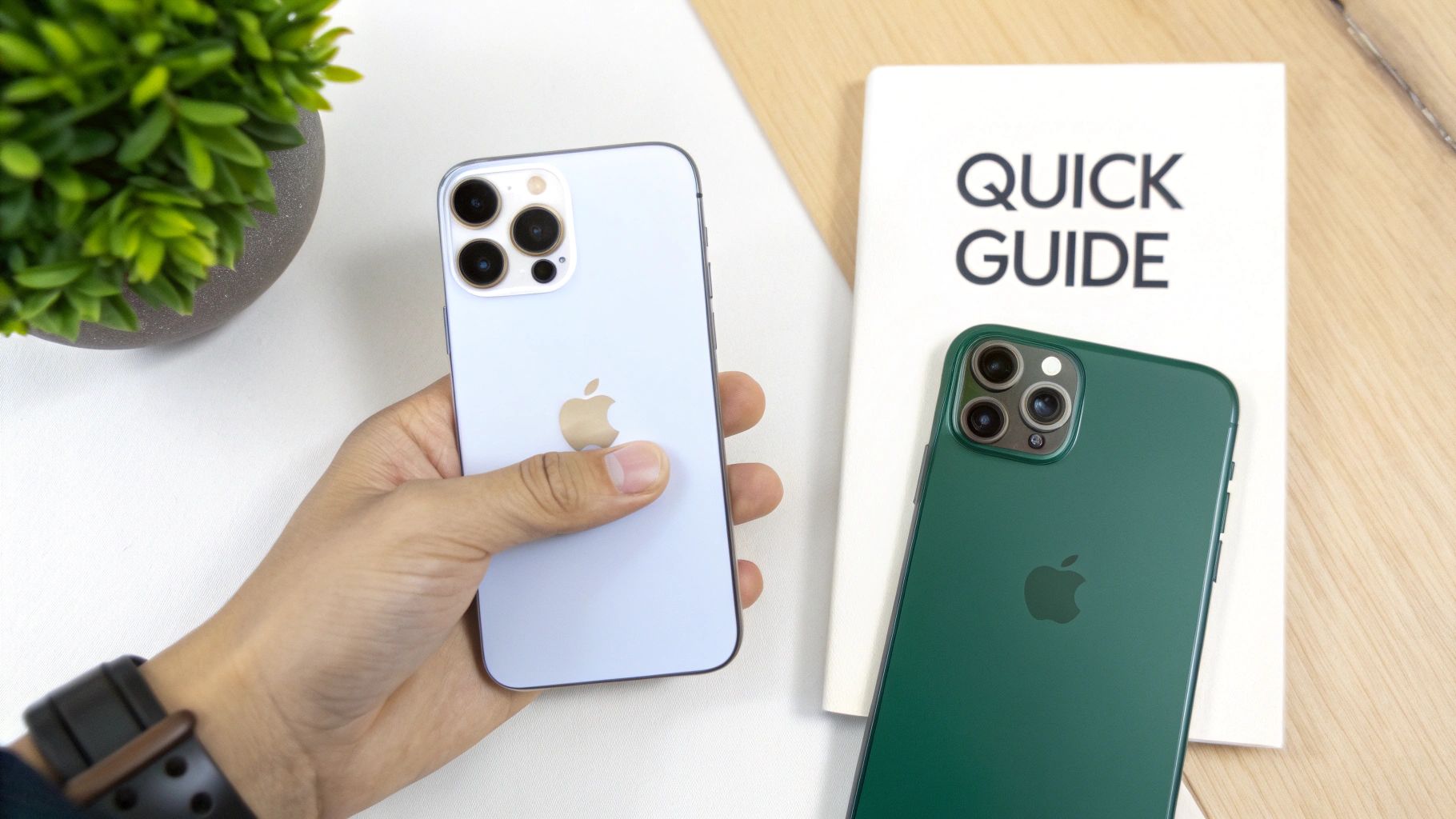
Looking at Apple's lineup can feel a bit overwhelming, but it really comes down to a few key decisions. While a shiny new flagship offers every bell and whistle, it might be overkill if you just need great shots for Instagram or family albums. This guide is here to help you quickly figure out which models are worth your attention as we dive deeper.
For many Aussies, a certified refurbished Pro model from a year or two ago hits the sweet spot between high-end performance and genuine value. Think of it like a certified pre-owned car: it has the premium features and has been professionally verified, but without the brand-new price tag. These phones often have features like a proper telephoto lens and ProRAW capabilities that still outclass new standard models.
Finding Your Perfect Match
To get a clear idea of what an upgrade really means for you, it helps to know what you're working with now. A quick check to determine your iPhone model will give you the perfect baseline for comparison.
Remember, the 'best' camera isn't a one-size-fits-all deal. It’s all about matching the right features to your life, whether you're a serious content creator, a parent capturing every milestone, or a traveller documenting your adventures.
The "best" iPhone camera isn't just about specs; it's about value. While the newest Pro Max leads in technology, an older, refurbished Pro model often delivers a superior photography experience for less than a new standard iPhone.
iPhone Camera Recommendations at a Glance
To help you get started, we've put together a quick cheat sheet. Think of it as a starting point to match your photography style with the right iPhone, highlighting the one killer feature that makes it a great choice for you.
| Your Photography Style | Top iPhone Recommendation | Key Camera Advantage |
|---|---|---|
| Professional Creator | Latest iPhone Pro Max | Most powerful zoom and Pro video features |
| Passionate Hobbyist | Refurbished iPhone 14/15 Pro | Pro features like telephoto at a lower cost |
| Social Media & Everyday Use | Refurbished iPhone 13/14 | Excellent main camera and great value |
| Budget-Conscious User | Refurbished iPhone 12 Pro | Access to a triple-lens system for less |
This table should give you a solid foundation as we explore the nitty-gritty details of each model's camera system in the sections below.
A Look Under the Hood: How iPhone Cameras Evolved
Before we dive into a head-to-head comparison, it helps to know what actually makes an iPhone camera so good. It’s not just one thing; it's the smart blend of powerful hardware and clever software working together that creates those incredible photos. Understanding this will help you see past the marketing buzz and focus on what really matters for your shots.
At its core, a few key hardware pieces define image quality. You’ve probably heard about megapixels (MP), but they don't tell the whole story. What's often more important is the sensor size. Think of a camera sensor like a bucket left out in the rain—a bigger bucket catches more rainwater. In the same way, a larger sensor gathers more light, which means clearer, brighter, and less grainy photos, especially when the lights get low.
Then there’s the aperture, which is the opening in the lens that lets light hit the sensor. It’s measured in f-stops (like f/1.8), and a lower number means a wider opening. A wider aperture is brilliant for night shots and also helps create that professional-looking background blur (called bokeh) in portraits.
The Magic of Computational Photography
Hardware is only half the battle. Apple's real secret weapon is computational photography—the advanced software processing that kicks in the instant you tap the shutter button. It’s how your iPhone can snap multiple images at once and intelligently stitch them together to create a single, superior photo.
This software magic is behind features like:
- Night mode: This feature works automatically to brighten up dark scenes by taking a series of shots at different exposures and combining the best parts of each one.
- Deep Fusion: Working behind the scenes in mid-to-low light, Deep Fusion analyses images pixel-by-pixel to pull out the best texture and detail.
- Smart HDR: This balances the bright skies and dark shadows in a high-contrast photo, making sure you don't lose important details at either end of the spectrum.
Over the years, Apple has steadily improved both its hardware and these software tricks. For example, the jump from the iPhone 11 Pro to the iPhone 12 Pro brought in some big sensor improvements, which we cover in our detailed iPhone 12 Pro vs 11 Pro camera comparison. Each new generation refines this formula, pushing what a phone camera can do even further.
How These Changes Impact Us in Australia
You can really see the impact of this evolution right here in the Australian market. With Apple holding a massive 58.42% market share, camera upgrades are a huge factor for people deciding whether to upgrade. A perfect example was the iPhone 13, which used a new diagonal camera layout just so it could fit a larger Wide sensor that captured 47% more light than the iPhone 12. That single change massively improved low-light photos, letting people capture stunning night shots of Aussie cityscapes and landmarks.
The biggest leaps in iPhone camera quality almost always come from combining bigger sensors with smarter software. It’s this teamwork that lets an iPhone turn a dimly lit scene into a bright, detailed memory.
But this progress isn't just about taking better holiday snaps. Beyond photography, the evolution of the iPhone camera powers some really cool augmented reality apps, like being able to Virtually Try On Glasses With Prescript AR. Understanding this steady march of improvement helps you appreciate the real-world differences between each model, which we'll get into next.
The Flagship Camera Battle: Pro vs. Pro Max
When you’re trying to figure out which iPhone has the best camera, the conversation always circles back to the flagship Pro models. This is where Apple pours in its best tech, but picking between the latest Pro and Pro Max isn’t just about screen size anymore. It’s a showdown of small but significant camera differences.
Let's get past the spec sheets and look at how these phones actually perform out in the real world. We’re talking about the practical impact of sensor size, the reach of a telephoto lens, and even how the physical size of the phone changes the way you shoot.
The Main Camera Showdown
At a glance, the main cameras on the Pro and Pro Max models look identical. Both pack a powerful 48MP sensor that churns out incredible detail, and their low-light performance is stunning. They achieve this with a clever trick called pixel binning, which essentially merges four pixels into one giant one to soak up more light.
Where you’ll feel the difference is in the handling. The standard Pro model is lighter and more compact, making it easier to whip out for a quick, candid shot. Picture yourself capturing the fast-moving street art in a Melbourne laneway—the agility of the smaller Pro could be the difference between nailing the shot and missing the moment entirely.
To really get what makes these cameras tick, this chart breaks down the key specs you should know.
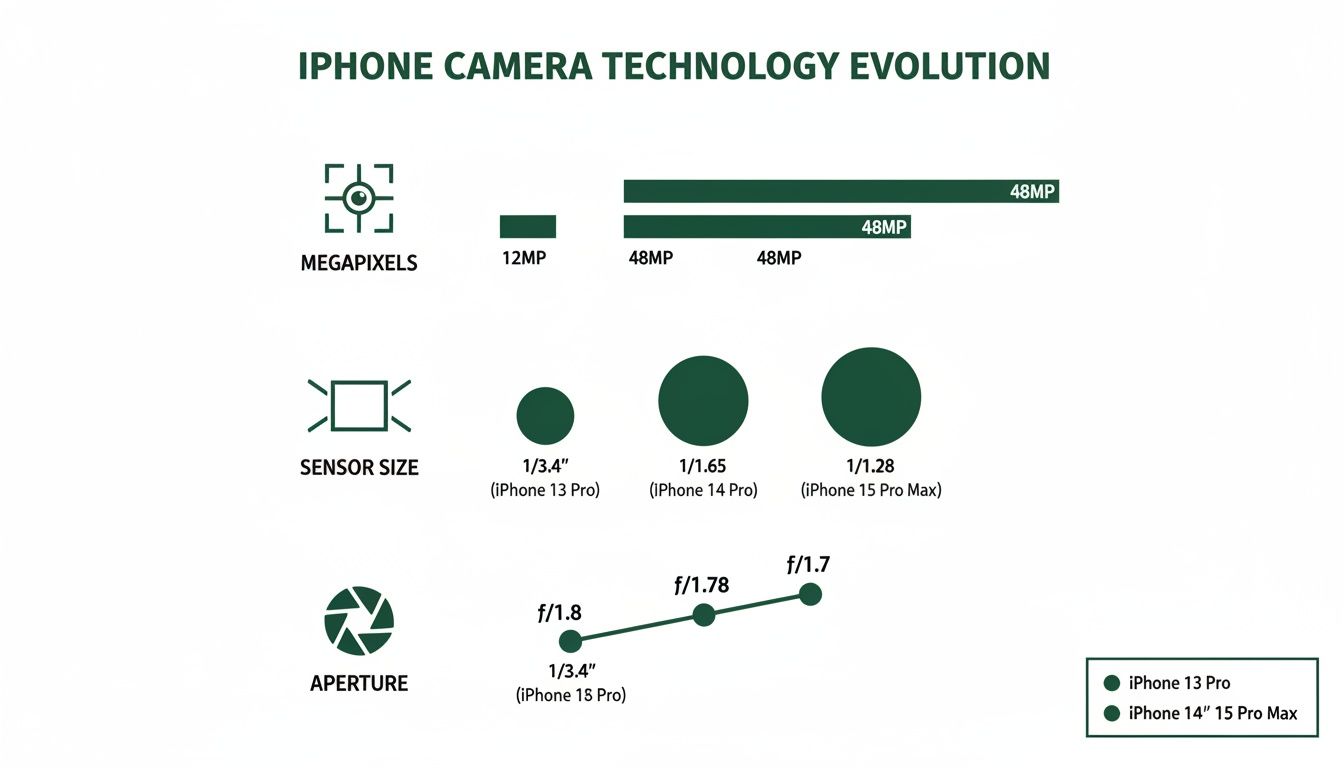
This visual guide shows how megapixels, sensor size, and aperture all work together to define the final quality of your photos. A bigger sensor and wider aperture are your best friends in low light, while more megapixels give you more freedom to crop in later.
The Telephoto Zoom Advantage
This is where the Pro Max has traditionally pulled ahead. For the last few generations, Apple has reserved its most powerful telephoto lens for the bigger Pro Max, giving it a longer optical zoom range. This isn't the grainy digital zoom you might be used to; it’s true optical magnification that preserves every last bit of detail.
Think about standing on the cliffs at Bells Beach, trying to frame a distant surfer. The Pro Max’s superior optical zoom gets you right into the action, delivering a crisp, clear shot that the standard Pro just can’t touch from the same spot. It makes the Pro Max the undisputed champ for anyone who regularly shoots sports, wildlife, or faraway landscapes.
The key differentiator is the zoom. If your photography often involves subjects you can't get close to, the Pro Max's extended optical reach is the single most compelling reason to choose it over the standard Pro.
Flagship iPhone Camera System Comparison
To lay it all out clearly, let's break down the key hardware and software features that separate the latest iPhone Pro from its Pro Max sibling. While they share a lot of the same DNA, the differences, especially in the zoom department, are what will likely drive your decision.
| Camera Feature | iPhone Pro | iPhone Pro Max |
|---|---|---|
| Main Camera | 48MP, f/1.78 aperture, 2nd-gen sensor-shift OIS | 48MP, f/1.78 aperture, 2nd-gen sensor-shift OIS |
| Ultra Wide Camera | 12MP, f/2.2 aperture, Macro photography support | 12MP, f/2.2 aperture, Macro photography support |
| Telephoto Zoom | 3x optical zoom | 5x optical zoom (Tetraprism design) |
| Digital Zoom | Up to 15x | Up to 25x |
| Video Recording | ProRes up to 4K at 60 fps, Cinematic mode, Action mode | ProRes up to 4K at 60 fps, Cinematic mode, Action mode |
| Image Processing | Photonic Engine, Deep Fusion, Smart HDR 5 | Photonic Engine, Deep Fusion, Smart HDR 5 |
As you can see, the core system is identical, but that 5x optical zoom on the Pro Max is a genuine game-changer for photographers who need that extra reach.
Nuances in Video and Low Light
Both models shoot absolutely exceptional video, including ProRes for professional workflows. However, the Pro Max’s slightly larger body can offer better heat dissipation during long 4K recording sessions. For a casual user, this is a non-issue, but for serious filmmakers pushing their device to the limit, it's a small but notable advantage.
In low light, both phones are stellar performers thanks to their large sensors and smart software. That said, some tests suggest the Pro Max can sometimes eke out a marginally cleaner image due to subtle hardware optimisations. The difference is minor, but for photographers who demand the absolute best in tricky conditions, it might be enough to sway them.
Expert analysis backs this up. In Australia, TechRadar's experts, who rigorously test phones, often name the Pro Max as the top camera phone. They consistently praise its lifelike photos, rich colour, and perfect balance, noting it outperforms previous models. One reviewer even found a recent Pro Max exceeded a professional Nikon D750 in low-light macro shots without a flash. You can read more about their expert camera phone tests on TechRadar.
Ultimately, the choice between the Pro and Pro Max comes down to your personal priorities:
- Choose the iPhone Pro if: You value a more compact, lightweight phone for everyday carry and candid shots, and you don’t need the longest zoom possible.
- Choose the iPhone Pro Max if: Maximum zoom is a must-have for your photography (like travel or sports), or you're a serious videographer who needs every ounce of performance.
Comparing Pro vs Standard iPhone Models
Deciding between a standard iPhone and its Pro sibling often comes down to a single question: is the ‘Pro’ camera system really worth the extra cash? For a lot of people, the answer depends entirely on what you plan to shoot and how much creative control you want.
Let's break down the real-world differences to help you figure out which camp you're in.
The most consistent and significant advantage the Pro models have is the dedicated telephoto lens. This isn't just a software trick; it's proper optical zoom. Think of it like swapping lenses on a DSLR—you get genuinely closer to your subject without sacrificing a shred of image quality, unlike the digital zoom on a standard model which just crops and enlarges the picture.
This feature is a true game-changer in specific situations. If you're at a national park trying to get a clear shot of a koala high up in a tree, the Pro's telephoto lens will deliver a crisp, detailed photo. A standard iPhone trying the same thing would produce a blurry, pixelated mess. It’s also brilliant for school sports days, concerts, or any time you physically can’t get closer to the action.
Beyond the Telephoto Lens
While the telephoto lens gets all the attention, other Pro features add up to a much more versatile and powerful photography toolkit.
- ProRAW Format: This is for anyone who loves editing their photos. A standard iPhone photo has a lot of Apple's processing "baked in," but ProRAW captures heaps more data. This gives you incredible precision to adjust exposure, colours, and details in apps like Lightroom.
- Superior Low-Light Performance: Pro models almost always have larger main camera sensors and wider apertures. This hardware advantage lets them capture more light, resulting in cleaner, brighter, and more detailed photos in dimly lit restaurants or after sunset.
- Advanced Video Features: For aspiring videographers, ProRes video is a huge plus. It offers professional-grade quality with richer colour information, making your footage far more flexible for colour grading in post-production.
For a deeper dive into how these features play out in a specific generation, our detailed guide on the iPhone 15 vs 15 Pro offers a direct, feature-by-feature comparison.
When the Standard iPhone is More Than Enough
Despite the Pro's advantages, it’s important to remember that the standard iPhone camera is absolutely fantastic for most people. If your camera roll is filled with shots of family get-togethers, sunny beach days in Queensland, and well-lit snaps for social media, the main camera on a recent standard model will serve you beautifully.
Apple makes sure its standard models get the same core computational photography magic—like Night mode and Deep Fusion—as the Pros. This means you still get sharp, vibrant, and perfectly exposed photos in a massive range of conditions without having to think twice.
The decision is practical, not just technical. If you rarely find yourself wishing you could zoom in closer or spend hours editing photos, the outstanding main camera on a standard iPhone is likely all you need to capture your memories beautifully.
Recent advancements have even started to blur the lines. For instance, the iPhone 16 Pro has taken photography in Australia to new heights with some impressive innovations. As noted in a hands-on review, the Pro model's 48MP main lens offers customisable focal lengths of 24mm, 28mm, and 35mm, allowing photographers to switch between classic prime lens perspectives for stunning high-res images. To see how these features perform in the real world, you can read the full hands-on review from TechGuide.
Ultimately, a Pro iPhone is an investment in creative flexibility. If your photography demands zoom, requires deep editing control, or frequently involves tricky lighting, the upgrade is often easy to justify. For everyday excellence, however, the standard iPhone remains a powerful and more wallet-friendly choice.
Matching an iPhone Camera to Your Lifestyle
It’s easy to get lost in the endless debate over specs and megapixels. But at the end of the day, the best camera is the one that fits how you actually live and shoot. The real key is to understand your own habits and find an iPhone that feels like a natural extension of your eye, not just a list of features you’ll never touch.
Let's connect the tech to your real life.
This means looking beyond the spec sheet and asking yourself some practical questions. Are you shooting professional-grade video for your business, or are you just trying to capture those chaotic, candid moments of your kids in the backyard? Your answer will point you toward completely different iPhones.
For the Social Media Creator
If your world revolves around creating scroll-stopping content for Instagram or TikTok, you’ll want features that deliver a polished, eye-catching look with minimal fuss.
- Portrait Mode: iPhones with an advanced Portrait mode, especially from the iPhone 13 series onwards, do an incredible job of separating your subject from the background. The blur looks natural and beautiful, making it perfect for professional-looking headshots or product photos that really pop.
- Cinematic Mode: This is the secret weapon for engaging video. It automatically shifts focus between people and objects, adding a dynamic, movie-like quality to your clips. It’s brilliant for telling a story in a short reel. A refurbished iPhone 13 or newer gets you this powerful tool.
For the Avid Traveller
When you’re exploring the vast landscapes of Australia—from the sweeping coastline of the Great Ocean Road to the majestic Blue Mountains—your camera has to capture the sheer scale of it all.
The Ultra Wide lens is a non-negotiable for travel photography. It’s the only way to fit towering landmarks, expansive vistas, and dramatic skies into a single frame, giving a sense of place that a standard lens just can’t replicate.
Every iPhone from the 11 series has an Ultra Wide lens, but the newer models produce sharper results, especially around the edges. On top of that, the telephoto lens on the Pro models is a massive help for zeroing in on distant wildlife or architectural details without sacrificing image quality.
For Parents Capturing Family Moments
For parents, speed and reliability are everything. Kids are a blur of constant motion, and those fleeting smiles or silly faces are gone in a flash. You need a camera that’s quick enough to freeze the action without turning it into a blurry mess.
Newer iPhones have much faster autofocus systems and beefed-up image processors. This means they can lock onto a moving target—like a toddler sprinting across the lawn—and snap a sharp photo with almost zero shutter lag. Features like the Photonic Engine (found on iPhone 14 and newer) are especially brilliant here, delivering better detail and colour in the tricky indoor lighting where so many family photos are taken.
For the Aspiring Videographer
If you’ve got ambitions of shooting short films, high-quality vlogs, or even professional client work, you need to be looking at the Pro models. They’re packed with creative tools that give you maximum control over the final look of your footage.
- ProRes Video: This professional video format captures a massive amount of colour information, giving you far more flexibility when you get to the editing and colour grading stage. Think of it as the video equivalent of shooting RAW photos.
- Action Mode: Introduced with the iPhone 14 series, Action mode delivers gimbal-like stabilisation for unbelievably smooth footage, even when you’re running or moving fast. It’s a genuine game-changer for capturing dynamic, professional-looking video without needing extra gear.
By matching these specific features to your own lifestyle, you can confidently pick a new or refurbished iPhone that doesn’t just have a great camera—it has the right camera for you.
Getting Pro Performance on a Budget
Chasing the absolute best iPhone camera usually points you straight to the newest, priciest Pro Max model. But what if you could get those professional-grade photography features—like a powerful telephoto lens and incredible low-light performance—for a fraction of the cost? This is where the savvy buyer wins, and it’s all about looking at certified refurbished models.
You really don’t need the latest device to capture stunning photos. A certified refurbished iPhone from a trusted marketplace like Trade.com.au delivers exceptional camera performance without the premium price tag. It's the smartest way to access high-end technology while keeping your budget and the planet in mind.
The Refurbished Pro Advantage
Here's the real secret to getting maximum value: compare an older Pro model against a newer standard model. A refurbished iPhone 14 Pro, for instance, often costs less than a brand-new standard iPhone 15 but comes loaded with a superior camera system.
This isn't just a minor difference. The older Pro model gives you a dedicated telephoto lens for true optical zoom—a feature completely missing on standard iPhones. It also typically packs a more advanced sensor and the ability to shoot in ProRAW, offering far greater editing flexibility for anyone serious about photography.
A one or two-year-old refurbished Pro iPhone almost always has a more versatile and powerful camera system than the latest standard model. You're getting flagship hardware from the recent past for a mid-range price today.
This makes it a clear winner for anyone who loves taking photos. You gain creative tools that are usually reserved for the most expensive phones, all by choosing a device that has been professionally restored to perfect working order.
Why an Older Pro Outshines a Newer Standard Model
Let's get practical and break down the benefits of choosing, say, a refurbished iPhone 14 Pro over a brand-new iPhone 15. While the standard model is newer, the 14 Pro holds a distinct edge in key photographic areas.
- True Optical Zoom: The iPhone 14 Pro has a 3x telephoto lens, letting you capture crisp, detailed shots from a distance without losing quality. The standard iPhone 15 relies on digital zoom, which is just cropping the image and always results in a grainier photo.
- Superior Low-Light Shots: With its larger main camera sensor, the 14 Pro gathers more light. The result is cleaner and brighter images in dimly lit environments—a hardware advantage that software can't fully replicate.
- ProRAW for Creative Control: For those who love editing, shooting in Apple ProRAW is a game-changer. It captures significantly more image data, giving you far more control over colours, shadows, and highlights in editing apps.
- Macro Photography: The Pro model's Ultra Wide lens can focus on subjects just centimetres away. This opens up a whole world of creative close-up photography that just isn't possible on the standard model.
This combination of features makes a compelling case for the refurbished Pro. To see how other models stack up, check out our complete guide to the best refurbished iPhones in Australia.
Peace of Mind with Certified Refurbished
One of the biggest worries when buying a pre-owned device is whether it will perform like new, especially something as complex as a multi-lens camera system. That's where certification makes all the difference.
At Trade.com.au, every single device undergoes a rigorous, multi-point inspection and testing process. Our expert technicians here in Australia ensure every component—from the main camera sensor to the LiDAR scanner and image stabilisation—functions perfectly. We guarantee that the camera on your refurbished iPhone will perform exactly as it did on day one.
Choosing a certified refurbished device isn't a compromise; it's a smart, sustainable decision. You get the pro-level camera you want, save a significant amount of money, and help reduce e-waste—all without sacrificing quality or performance.
Your Top iPhone Camera Questions Answered
When you're diving deep into camera specs, a few questions always pop up. To help you make that final call with total confidence, here are some clear, no-nonsense answers to the questions we get asked most often by our customers right here in Australia.
Is the Jump from 12MP to 48MP Really a Big Deal?
Yes, but probably not for the reason you think. The 48MP sensor on the Pro models isn't just about making your photos four times bigger. It uses a clever trick called 'pixel binning' to merge four pixels into one super pixel, which pulls in a huge amount of extra light.
The real-world result is dramatically better 12MP photos, especially when the lights are low. It also unlocks the ability to shoot in 48MP ProRAW, giving you incredible detail to play with when you're editing. For your everyday snaps, though, the main benefit is simply cleaner, brighter, and sharper images.
Do I Sacrifice Camera Quality if I Buy a Refurbished iPhone?
Absolutely not, especially when you buy from a trusted marketplace like Trade.com.au. We know the camera is one of the most critical features on your phone. That’s exactly why every single device we sell goes through a rigorous, multi-point testing process right here in Australia.
Our expert technicians check every part of the camera system—from the lenses and sensors to the image stabilisation—to ensure it all functions perfectly. We guarantee the camera performs just as it did when it was brand new, so you get that premium hardware experience without the premium price tag.
Choosing a certified refurbished iPhone doesn't mean you're compromising on camera performance. You're just making a smarter, more sustainable choice that puts professional-grade camera features within reach for less.
Which iPhone Has the Best Zoom?
The 'Pro Max' models are always the champions of zoom. Apple consistently equips them with its most advanced telephoto lens, giving them the longest optical zoom range available.
Optical zoom is the key here. It uses the actual lens hardware to get you closer to your subject without losing a shred of image quality. This is worlds apart from digital zoom, which just crops the image and blows it up, leaving you with a grainy, soft mess. If you're often shooting things far away—wildlife, your kids' sports games, or cool architectural details—a Pro Max model is easily your best bet for crisp, clear shots.
What is Cinematic Mode and Who Should Use It?
Think of Cinematic Mode as your own personal director. It's an intelligent video feature that creates that professional-looking, blurred background effect (known as depth-of-field) you see in movies. It even automatically and smoothly shifts focus between people or objects in the frame to guide the viewer's attention.
It's a brilliant tool for content creators, aspiring filmmakers, or even parents who want to capture more dynamic and engaging videos of their family. One of its killer features is that you can actually edit the focus point after you’ve finished recording, giving you amazing creative control over the final cut.
Ready to find the perfect camera for your budget and your creativity? At Trade.com.au, we offer a huge range of certified refurbished iPhones, and every single one is rigorously tested to ensure flawless camera performance. Explore our collection today and get pro-level photography power for a whole lot less.