

MacBook Pro Prices in Australia: An Insider's Guide to Finding Value
Trying to pin down the exact price of a MacBook Pro in Australia can feel like you're chasing a moving target. The short answer? A brand-new model direct from Apple will set you back anywhere from $2,699 to over $6,000. On the other hand, a quality refurbished one often lands between $1,500 and $4,000, offering huge savings for almost identical performance.
Your Quick Guide to MacBook Pro Prices in Australia
Figuring out MacBook Pro costs isn't about finding a single magic number. The price you'll pay exists on a spectrum, and it's shaped by one big decision: are you buying brand new, certified refurbished, or a second-hand device from a private seller?
Think of these categories as different paths to owning a great machine. Each one is built for a different type of buyer—whether you're a professional who needs the latest and greatest, a student on a budget, or a savvy shopper hunting for the best possible value.
Typical MacBook Pro Price Ranges in Australia
To give you a clearer picture before we dive into the details, here's a quick look at what you can expect to pay. This table will help you find your budget's sweet spot.
| Condition | Typical Price Range (AUD) | Best For |
|---|---|---|
| New (Direct from Apple) | $2,699 – $6,000+ | Professionals and creatives needing the absolute latest tech and a full warranty. |
| Certified Refurbished | $1,500 – $4,000 | Students, small businesses, and anyone looking for top-tier performance without the premium price tag. |
| Used (Private Seller) | $800 – $3,000 | Bargain hunters who are comfortable with higher risk and no warranty protection. |
As you can see, the path you choose makes a huge difference. Let's break down what each of these options really means for your wallet and your peace of mind.
New vs. Refurbished vs. Used: What’s The Difference?
- New (Direct from Apple): This is the top-shelf option. You get the latest model straight from the factory, a full warranty, and that unmistakable new-product smell. It comes with the highest price tag, but it's the go-to for professionals who need peak performance from day one.
- Certified Refurbished (Like Trade.com.au): This is where you’ll find the best value, hands down. Think of it like a certified pre-owned car—it’s been professionally inspected, cleaned, and comes with a warranty, saving you 15-40% off the original retail price. It's the perfect middle ground for students, businesses, and anyone who wants a reliable, high-quality Mac without paying the "Apple tax".
- Used (Private Sellers): This can be the cheapest route, but it's also the riskiest. You might score a deal on Facebook Marketplace or Gumtree, but there’s no warranty, no professional testing, and no guarantee of the device's history or condition.
Getting your head around these tiers is the first step to making a smart purchase. It’s all about balancing cost, condition, and confidence.
Why Are MacBooks More Expensive in Australia?
It's the classic Aussie tech dilemma. You see a new MacBook Pro launched in the US, do a quick currency conversion on the advertised price, and then your jaw hits the floor when you see what it costs on the Australian Apple Store. What gives?
This price gap is so common it’s often dubbed the "Australia tax," and it’s a very real thing. It's not just Apple deciding to charge us more for the fun of it; a bunch of local factors come together to inflate the final price.
Think of it like getting a great bottle of wine. A Shiraz from the Barossa Valley has a simple journey to your local bottle shop. But a French Bordeaux has to be imported, clear customs, pay duties, and get shipped by a local distributor—every step adds a cost. It's the same deal with premium tech.
Breaking Down The Added Costs
So, why are MacBook Pro prices in Australia always higher than a straight currency conversion from the US RRP (Recommended Retail Price)? It boils down to a mix of taxes, logistics, and the realities of doing business down under.
Here are the main culprits behind that price hike:
- Goods and Services Tax (GST): This is the big one. Australia has a 10% GST that's baked into the final price you see. In the US, prices are usually shown before sales tax because it varies by state. Right off the bat, our price tag is 10% higher.
- Import Duties and Tariffs: Getting high-value electronics into the country isn't free. There are import duties and other administrative fees that get absorbed into the final cost you pay at the checkout.
- Local Distribution and Retail Margins: A MacBook doesn't just magically appear in a store. It has to go through a local supply chain—Apple Australia, authorised resellers, and logistics partners—all of whom have costs like warehousing, staff, and marketing to cover.
- Currency Fluctuation Buffers: Global companies like Apple often set their Australian prices with a built-in buffer to protect themselves from a sudden dip in the AUD-USD exchange rate, ensuring their profits stay stable.
The Real-World Price Premium
When you add all those factors up, the difference becomes pretty significant.
An analysis from the Apple Price Index found that, on average, Australians paid about 26.5% more than their US counterparts for the same Mac products when comparing baseline prices. For MacBook Pro models, this premium often lands somewhere between 15% and 30%, even after you account for the exchange rate.
It’s a long-standing gap that comes from the economic realities of selling products in our market. You can dive into the nitty-gritty and see how this plays out across different countries in this illustrated Apple Price Index study.
Knowing why the price is higher doesn't make it cheaper, of course, but it gives you crucial context. It tells you that when you're looking at MacBook Pro prices Australia-wide, you're seeing a figure that reflects the true cost of bringing that device here. It also explains why savvy Aussie buyers are increasingly turning to the local refurbished market to get far better value for their money.
Decoding The Price Tag: Key Factors That Drive Cost
The price of a MacBook Pro isn't pulled out of a hat. It's a direct reflection of its power and capabilities. Understanding the key components that build its final price tag is the secret to finding the best value and avoiding overpaying for features you just don't need.
Think of it like customising a car. The base model has a set price, but adding a more powerful engine or a larger screen will bump up the final cost. A MacBook Pro works in exactly the same way. The chip, screen size, memory, storage, and condition are what create the huge difference in MacBook Pro prices Australia-wide.
The diagram below shows how external factors build upon a base price to create what we end up paying here.
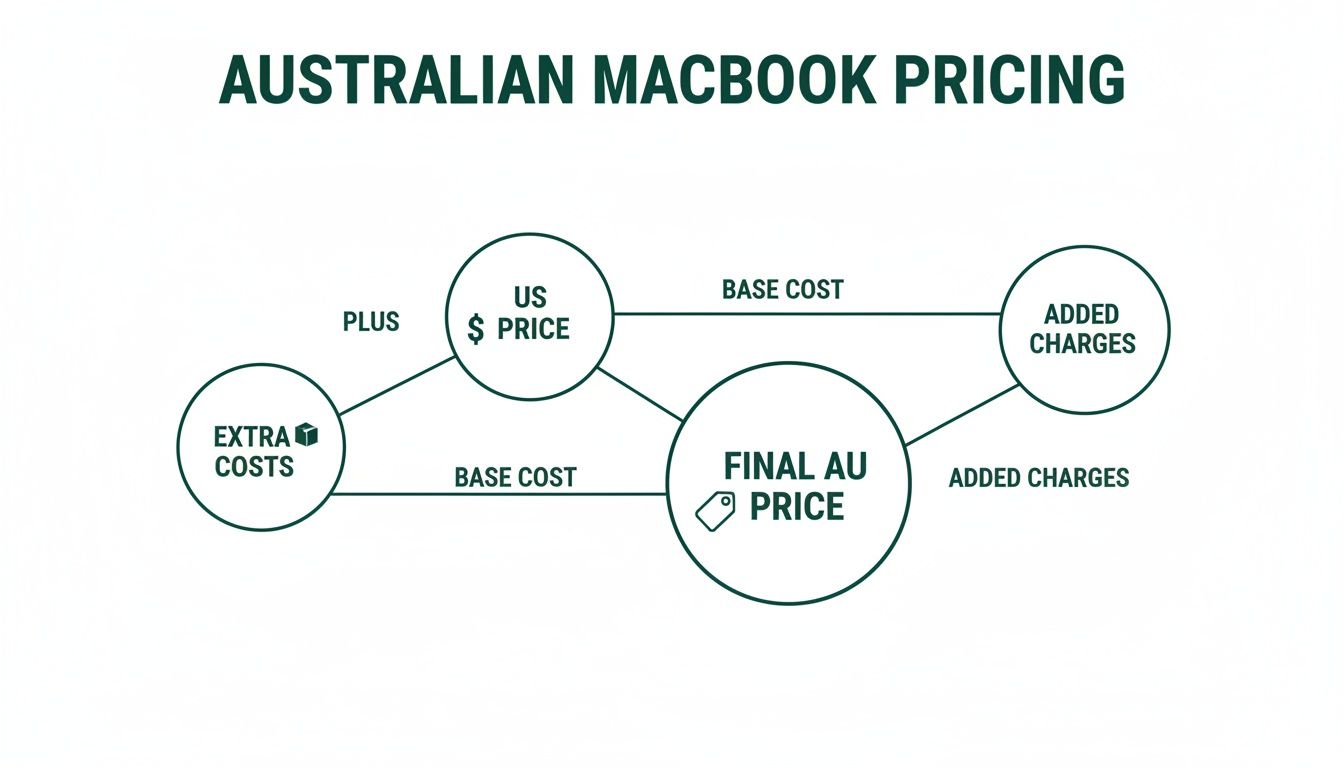
This shows how the journey from the US sticker price to what we pay in Australia involves several layers of added costs. Now, let's get into the factors you can actually control.
The Engine Room: Apple's Silicon Chips
The single biggest factor dictating a MacBook Pro's price is the chip inside it. This is the device's brain and engine all rolled into one. Whether it’s an M1, M2, or the latest M4 chip—and whether it’s the standard, Pro, or Max version—this choice is the main driver of both performance and cost.
For example, a MacBook Pro with an M3 chip will be significantly cheaper than its M4 counterpart. Stepping up from a Pro to a Max chip can add hundreds of dollars to the price, but you get more graphics cores for intense video editing or 3D rendering. For most people, including students and small business owners, the standard or Pro chip delivers more than enough grunt for daily tasks.
Screen Size: Bigger Is Pricier
Apple generally offers the MacBook Pro in two main sizes: 14-inch and 16-inch. The choice here is a classic trade-off between portability and screen real estate.
Predictably, the larger 16-inch models command a higher price. This isn't just because the screen is bigger; they often come with slightly better base specs or more robust cooling systems. If you're a graphic designer or video editor who needs that large canvas, the extra cost might be justified. If you're always on the move, a 14-inch model can save you a good chunk of cash.
Memory (RAM): For Smooth Multitasking
RAM, or Unified Memory as Apple calls it, is like your computer's short-term memory. It's what determines how many apps you can run smoothly at the same time without everything grinding to a halt.
The secret to spec'ing Apple silicon Macs correctly is all about getting the memory option right. Choosing a model without enough memory is what will cause buyer's remorse down the line.
Base models typically start with 8GB or 16GB of memory. Upgrading to 32GB or more is a pricey step, but it's essential for professionals working with enormous files. For everyday browsing, document editing, and light photo work, 16GB is the sweet spot for both performance and value. It’s critical to remember that you can't upgrade the memory later on, so it's a decision you have to get right from the get-go.
Storage (SSD): Your Digital Filing Cabinet
Your MacBook Pro's storage is where all your files, photos, and applications live. Apple uses lightning-fast Solid-State Drives (SSDs), and the price climbs sharply with capacity.
Doubling your storage from 512GB to 1TB can add $300 or more to the price. While having heaps of internal storage is convenient, it's one of the easiest areas to save money. You can opt for a smaller internal SSD and pair it with fast, affordable external SSDs. For instance, our deep dive into the classic 2019 MacBook Pro 16-inch model shows how even older powerhouses can be a smart buy if you manage storage wisely.
Condition: The Ultimate Price Shaper
Finally, the condition of the MacBook Pro itself is a massive price determinant.
- New: Straight from the factory, offering the latest technology at the highest price.
- Certified Refurbished: Professionally tested, cleaned, and warrantied. This is often the value sweet spot, frequently 15-40% cheaper than new.
- Used: Purchased from a private seller, usually with no warranty. It's the cheapest route but carries the most risk.
By understanding these five factors, you can shift from being a price-checker to a value-hunter, ensuring you get the perfect MacBook Pro for your needs and your budget.
New, Refurbished, Or Used: Which Path Is Right For You?
Choosing how you buy your MacBook Pro is just as important as picking the right model. The path you take—brand new, certified refurbished, or privately used—is the single biggest factor affecting what you'll pay and the peace of mind you'll get.
Buying new gives you that fresh-out-of-the-box thrill, but it comes with the highest price tag. At the other end, a used MacBook might look like a bargain, but it's a gamble with serious risks. For most savvy Aussies, the smart money is right in the middle. Certified refurbished devices hit that perfect sweet spot between value, quality, and security.
Comparing Your MacBook Pro Buying Options
Deciding between new, refurbished, and used can feel tricky. This table cuts through the noise to give you a clear, at-a-glance comparison, helping you find the perfect fit for your budget and needs.
| Factor | New (Apple Store) | Certified Refurbished (e.g., Trade.com.au) | Used (Private Seller) |
|---|---|---|---|
| Price | Highest possible price | 15-40% cheaper than new | Lowest price, but variable |
| Warranty | Full 1-year manufacturer warranty | Comprehensive warranty included | None - sold 'as is' |
| Condition | Pristine, factory-sealed | Professionally tested, cleaned, and restored | Unknown, varies wildly |
| Inspection | Factory quality control | Rigorous multi-point professional check | None - it's up to you |
| Risk Level | Very low | Low - backed by seller | Very high - "buyer beware" |
| Best For | Professionals needing the latest tech | Savvy buyers wanting value and security | Tech-savvy users with a high risk tolerance |
The biggest differences come down to price, warranty, and risk. While a brand-new machine offers the ultimate assurance, the value proposition of a certified refurbished device is hard to ignore.
The Brand New Experience
Going for a brand new MacBook Pro direct from Apple is the premium choice. You're guaranteed the very latest M-series chip, the newest design, and a full one-year manufacturer's warranty.
- Pros: You get the most recent technology, maximum warranty and support, and that untouched, straight-from-the-factory experience.
- Cons: It's by far the most expensive route. You're paying a hefty premium to be the first owner, and its value starts depreciating the moment you break the seal.
This path is best for professionals or businesses who need the absolute best performance and can't afford any compromises. For many, the decision involves similar financial logic to understanding the advantages of leasing over purchasing—it’s all about balancing upfront cost with long-term value.
The Wild West of Used Devices
Hunting for a used MacBook Pro on places like Gumtree or Facebook Marketplace can feel like a treasure hunt. You might snag a bargain, but you could just as easily end up with a lemon.
A "used" device is sold as-is, straight from the previous owner. There’s no professional inspection, no certified cleaning, no guaranteed data wipe, and most importantly, absolutely no warranty. Any hidden problems with the battery, screen, or logic board become your headache the second the cash changes hands.
While the low upfront price is tempting, the potential for costly repairs and the complete lack of buyer protection make it the riskiest way to buy. It's a true "buyer beware" situation.
This route is really only for those with a high tolerance for risk and the tech skills to thoroughly check out a machine themselves before handing over any money.
The Smart Middle Ground: Certified Refurbished
This is where you find the real value. A certified refurbished MacBook Pro isn't just "used"—it's a pre-owned machine that has been professionally restored to perfect working order by experts.
At Trade.com.au, every refurbished device goes through a rigorous, multi-point inspection. Our technicians test everything: the battery, screen, ports, keyboard, and all internal components. The machine is then professionally cleaned, sanitised, and factory reset, so it looks and performs like new.
The key difference? Peace of mind.
- Huge Savings: You can save anywhere from 15% to 40% compared to buying the same model new.
- Professional Certification: Every device is backed by a meticulous testing process to ensure it meets our high standards.
- Warranty Included: Unlike a private sale, our certified refurbished MacBooks come with a comprehensive warranty, just like a new product would.
Choosing refurbished is like buying a certified pre-owned car from a reputable dealership instead of a random one from a classified ad. You get a high-quality, reliable machine that’s been thoroughly checked, all while keeping hundreds of dollars in your pocket. To learn more, check out our guide to buying a refurbished MacBook in Australia.
Thinking Long-Term: The True Value Of A MacBook Pro
A MacBook Pro is an investment in your productivity. When you look at MacBook Pro prices Australia offers, it’s easy to focus on the initial number. But the real story is its incredible long-term value.
The true cost of any tech isn't just what you pay on day one. It’s the "total cost of ownership," which is a fancy way of asking: how much value does it hold onto over time? This is where MacBooks consistently leave their competitors in the dust, holding their resale value remarkably well.
Think of it like buying a car. Two cars might have a similar sticker price. But if one is worth 60% of its original price after three years and the other is only worth 30%, the first one was obviously the much smarter financial decision. You pay a premium at the start, but you get a huge chunk of that money back when it's time to sell or trade it in.
The Power Of Slow Depreciation
So, what's the secret? It comes down to a MacBook Pro's incredibly slow depreciation. Thanks to Apple's premium build quality, powerful software that gets updates for years, and a rock-solid brand reputation, these machines stay in high demand long after they're first unboxed.
This means the money you spend isn't just gone—it's parked in a high-performing asset. A three-year-old MacBook Pro can often be sold for a price that covers a massive chunk of a new or refurbished model, making your upgrade cycle surprisingly affordable.
A MacBook Pro pays for itself over its lifespan. The combination of longevity, reliable performance, and high resale value means the initial higher cost is offset by years of dependable use and a strong return when you decide to upgrade.
A Look At Historical Pricing And Value
Here's an interesting fact: while the technology has taken massive leaps, the sticker price for new models in Australia has remained surprisingly stable in real terms. When Apple launched the 15-inch Retina MacBook Pro back in mid-2012, the base model would have set you back A$2,699.
Fast forward to 2024, and the far more powerful 14-inch M4 MacBook Pro launched at A$2,399. When you factor in over a decade of inflation, today’s models give you exponentially more power for what is effectively a lower price, as you can see in these historical price compilations.
This long-term price stability, paired with their strong resale value, just reinforces the idea that you’re buying a tool that holds its worth. For creators and professionals eyeing a MacBook Pro for demanding tasks like streaming, this value extends to how it fits into a complete workspace. You might find it useful to check out a comprehensive budget-friendly streaming setup guide.
This long-view perspective is crucial. Once you shift your focus from the initial purchase price to the total cost of ownership, you start to see why paying a bit more upfront—especially for a certified refurbished model—can be the smartest financial move you make.
Actionable Strategies For Finding The Best Deals
Knowing the market is your biggest advantage when navigating MacBook Pro prices Australia-wide. That knowledge translates directly into savings, letting you land a fantastic machine without overpaying. It's less about luck and more about being strategic.
Think of this as your game plan for getting a great deal. We'll walk through a few proven tactics, from timing your purchase to being smart with trade-ins, so you can squeeze the most value out of every dollar.
Time Your Purchase Like A Pro
One of the easiest ways to save is to simply buy at the right time. The tech world runs on a predictable schedule, and you can use that to your advantage.
- Post-Keynote Price Drops: The golden window to buy is often right after an Apple event where new models are unveiled. Retailers scramble to clear out the "old" stock, which means serious discounts on last-generation MacBook Pros that are still incredibly powerful.
- Annual Sales Events: Mark your calendar for the big sales. Black Friday, Cyber Monday, and the Back-to-School season are prime times to find deals on both new and certified refurbished models.
Unlock Educational And Business Discounts
Are you a student, teacher, or buying for a business? You might be eligible for special pricing that the general public doesn't get.
Apple offers educational discounts for university students and educators, which can shave a nice percentage off the sticker price. In the same way, businesses purchasing multiple machines can often negotiate better rates. It never hurts to ask what programs you qualify for before you check out.
Master The Art Of The Trade-In
That old laptop sitting in your cupboard is more valuable than you think. Instead of letting it collect dust, put it to work to lower the cost of your shiny new MacBook Pro. A trade-in is one of the quickest ways to reduce your upfront cost.
Trading in your old device isn't just a discount; it's a smart financial move. It directly reduces the purchase price of your new machine, making a high-end MacBook Pro far more accessible.
Platforms like Trade.com.au make this whole process straightforward. You can get an instant quote for your old gear and apply that credit directly to your purchase. Not only does this save you money, but it also means your old tech gets responsibly recycled or a new lease on life—a win for your wallet and the planet.
Be Smart About Your Specs
We've already touched on how much your chosen specs can swing the final price. A classic mistake is paying a premium for a massive internal hard drive you might not need. A recent analysis drove home a key lesson for modern Macs: spend your money on memory (RAM), not storage.
You can often save hundreds of dollars by choosing a model with a smaller internal SSD and pairing it with a speedy external drive for your bulky files. For a deeper dive into balancing features and cost, check out our guide on finding cheap MacBook computers that still pack a punch. By being deliberate with your configuration, you ensure you're only paying for the power you'll actually use.
Answering Your Top Questions
Deciding on a MacBook Pro often comes with a few common questions. To help you feel confident in your choice, we’ve put together clear, straightforward answers to the queries we hear most often.
When Is The Best Time To Buy A MacBook Pro In Australia?
Timing is everything. The smartest times to look are usually right after Apple announces a new lineup of MacBooks. This is when retailers and marketplaces start clearing out older stock to make room for the latest models.
You should also keep your calendar marked for major sales events. Black Friday in November and the Back-to-School season (typically January-February) are prime opportunities to find discounts on both brand-new and certified refurbished machines.
Is Buying A Refurbished MacBook Pro A Safe Choice?
Absolutely, as long as you buy from a reputable seller like Trade.com.au or Apple directly. Unlike taking a chance on a used device from a private seller, certified refurbished models go through extensive professional testing, repairs, and cleaning.
The real difference-maker is the guarantee. A trusted refurbisher backs their products with a comprehensive warranty. You get the significant savings of a pre-owned device, but with the security and peace of mind you'd expect from buying new.
It’s genuinely the best of both worlds—fantastic value paired with solid reliability.
How Much Can I Realistically Save With A Refurbished Model?
The savings are significant. You can typically expect to pay between 15% and 40% less than the original retail price for the same machine. The exact discount will depend on the model's age, its specs, and its cosmetic condition.
This means you can often afford a more powerful, higher-spec MacBook from a previous generation for the same price as a brand-new, entry-level model today. It's a brilliant way to get more performance for your dollar.
Are Refurbished MacBooks Covered By Australian Consumer Law?
Yes, they are. When you purchase a refurbished product from an Australian business, your purchase is protected under Australian Consumer Law (ACL). This is a crucial safety net that you simply don't get when buying from a private seller.
The ACL ensures that goods must be of acceptable quality and fit for the purpose they were sold for. This consumer guarantee gives your investment an extra layer of security, ensuring the device you receive meets a reasonable standard of quality.
Ready to find a great deal on a MacBook Pro that’s been professionally tested and backed by a warranty? At Trade.com.au, we offer a wide range of certified refurbished MacBooks to suit any budget and need. Explore our collection of verified Apple devices today!